Heat Pumps
Heat Pump Water Heater Canada: A Practical Buying Guide
By Brandon Fraser · · 9 min read
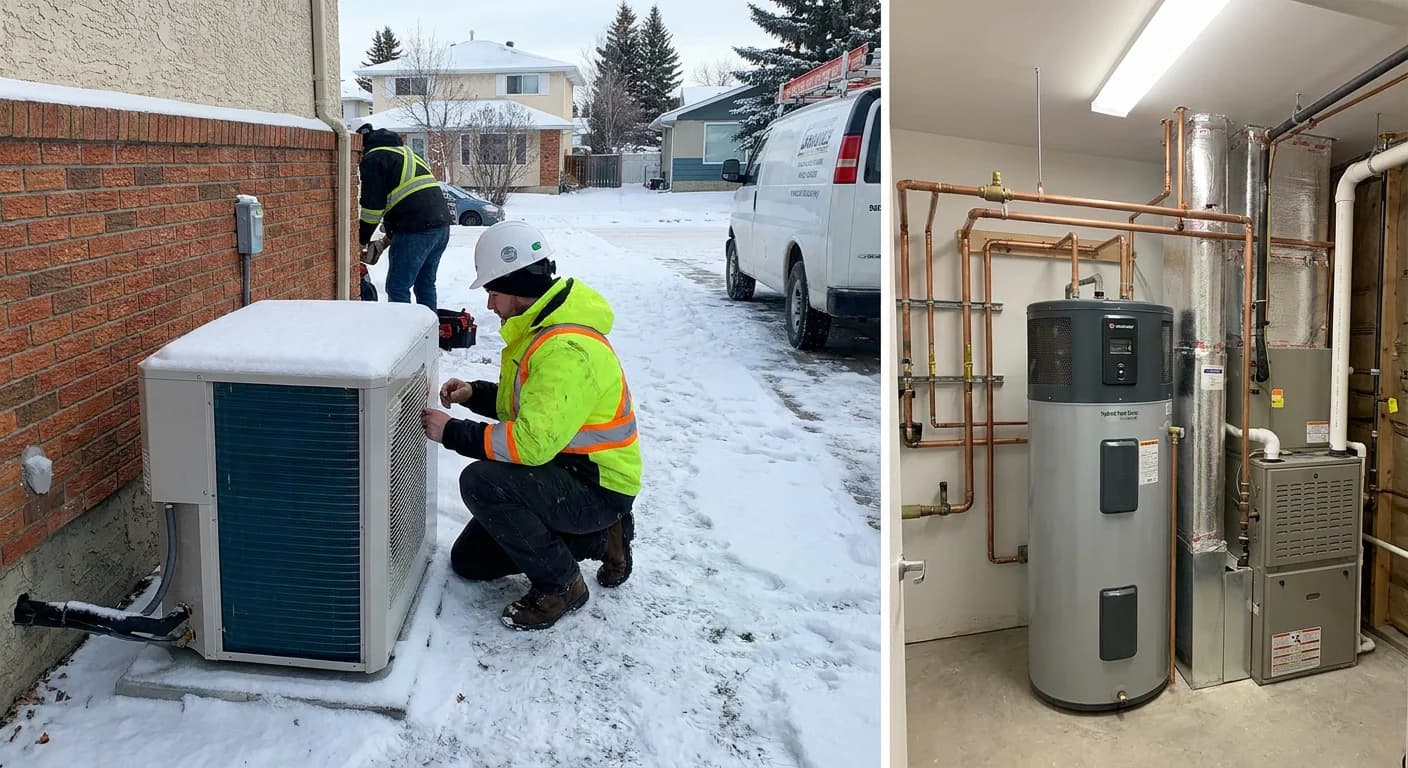
TL;DR
A heat pump water heater in Canada can sharply reduce water-heating electricity use, but the installation space matters. This guide covers efficiency, cold-weather performance, sizing, electrical requirements, rebates, product specifications and common problems, helping homeowners compare the technology with standard electric and gas-fired equipment.
How Does a Heat Pump Water Heater Work?
A heat pump water heater moves existing heat into a storage tank instead of producing all its heat through electric resistance. It works much like an air conditioner operating in reverse.
The evaporator collects heat from the surrounding air. A compressor raises the refrigerant temperature, and a condenser transfers that energy into the stored water. The process can deliver several units of heat for each unit of electricity consumed.
Most residential products are hybrid units. They combine a heat pump with electric resistance elements. The heat pump handles normal demand efficiently, while the elements can assist during heavy use or unsuitable operating conditions.
Natural Resources Canada says an ENERGY STAR certified unit can be up to four times more efficient than a conventional electric water heater. It may use up to 70% less energy under suitable conditions. Consumers can review NRCan water heater guidance before comparing models.
Efficiency is commonly expressed through the Uniform Energy Factor, or UEF. A higher UEF indicates better tested performance. Current certified hybrid models often have ratings near 4.0, while conventional electric storage tanks are generally much lower.
We treat the tank, heat pump, electrical supply and surrounding room as one system. A high-efficiency product may underperform if it lacks enough air or sits in a cold enclosure.
Is a Heat Pump Water Heater in Canada Worth It?
It can be worthwhile when replacing an electric resistance tank, especially in a warm, open mechanical area. The decision is less straightforward when comparing it with natural gas because local utility rates, installation work and household demand all matter.
Canadian weather does not automatically rule out the technology. Unlike an outdoor space-heating heat pump or ductless mini-split, an integrated water heater usually draws heat from its installation room. Basement and utility-room temperatures matter more than the outdoor temperature alone.
Many current products stop compressor operation when surrounding air falls to roughly 3°C. The unit may then rely more heavily on electric elements. That keeps hot water available, but it reduces the efficiency advantage.
Choosing a heat pump water heater in Canada also means accounting for its effect on the building. The appliance cools and dehumidifies surrounding air while operating. That can be useful in a warm, damp basement during summer. During a Calgary winter, it can add to the space-heating load.
A unit that operates in a cool room does not necessarily meet that household’s hot-water demand efficiently. Recovery rate, tank volume and backup operation remain separate questions.
In our projects, we review the existing fuel, panel capacity, room temperature and plumbing layout before recommending a system. We also consider where the extracted heat ultimately comes from during heating season.
What Are the Downsides of a Heat Pump Water Heater?
The main disadvantages are higher installation complexity, slower heat-pump recovery, indoor cooling, compressor noise and specific airflow needs. These limits are manageable in many homes, but they should be assessed before equipment is ordered.
- Space requirements: An integrated unit needs enough surrounding air for heat exchange. A tight closet may require louvres, ducting or another design.
- Cool exhaust air: The system lowers the temperature around it. That may make a finished basement or nearby room uncomfortable.
- Condensate: Moisture removed from the air must drain safely. The drain route is an essential part of the installation.
- Noise: A compressor and fan make more sound than a standard electric tank. Placement near bedrooms or offices deserves careful review.
- Recovery time: Heat-pump-only operation can restore tank temperature more slowly than resistance or gas heating.
- Upfront work: Electrical, drainage, ducting and plumbing changes can make the retrofit more involved than a like-for-like tank replacement.
Hybrid modes address peak demand by using resistance elements, but frequent element operation increases electricity consumption. A smaller tank running aggressively can be less effective than a properly sized larger unit.
We often find that equipment location decides whether the project makes sense. A spacious mechanical room can be favourable. A cold exterior closet may create avoidable performance and comfort problems.
Sizing and Installation Requirements
Tank capacity alone does not determine whether a unit will keep up. First-hour rating is equally important because it estimates available hot water during the first hour of heavy use.
A household with several showers running close together needs a different design than one with staggered demand. Large tubs, high-flow fixtures and simultaneous appliance use also affect the choice. Oversizing without reviewing the room and electrical service can create different problems.
Key installation checks include:
- Storage volume and first-hour rating
- Normal and peak hot-water demand
- Room temperature through the winter
- Available room volume and airflow
- Ceiling height and service clearances
- Condensate drainage
- Electrical panel capacity and circuit requirements
- Water piping, shutoffs and mixing controls
- Noise transfer into occupied rooms
- Ducting options for intake or exhaust air
Residential examples commonly use a 240-volt supply. Listed maximum current varies by model, with researched examples ranging from 21 to 27 amperes. Not every existing water-heater circuit is suitable.
Electrical, refrigerant and regulated plumbing work may require permits and qualified trades. Requirements must be confirmed for each property and municipality.
Our team coordinates the mechanical and building trades when a retrofit crosses several scopes. That may include plumbing, electrical, sheet metal, controls and interior repairs. This approach helps prevent the tank from arriving before the room, drain or power supply is ready.
What Rebates Are Available for Heat Pump Water Heaters?
Rebate availability depends on the province, utility, installation date and chosen product. Homeowners should never assume that a water-heating unit qualifies because another type of heat pump appears in a program.
The Canada Greener Homes Grant previously included eligible heat pump water heaters, but it closed to new submissions at the end of 2025. Applications for the related loan closed on October 1, 2025.
The announced National Heat Pump Rebate focuses on space-heating heat pumps and does not cover hybrid hot-water tanks.
Ontario’s Home Renovation Savings program describes a $500 rebate for a qualifying unit within its assessment-based bundle of upgrades. The product must be ENERGY STAR certified and appear on the applicable NRCan list. Homeowners must confirm current eligibility and requirements directly through the Home Renovation Savings program.
Calgary’s Clean Energy Improvement Program offers financing for eligible property upgrades. Its public materials discuss heat pumps and other efficiency measures, but property owners should confirm whether their proposed water-heating equipment is eligible.
Canada is also developing federal efficiency rules for this product category. NRCan has proposed definitions, testing methods and reporting requirements aligned with US Department of Energy practices. The contemplated household standard includes a minimum UEF of 2.30 for certain units manufactured on or after May 6, 2029.
Program rules change. We advise clients to verify the model number, purchase timing, contractor requirements and approval process before relying on financial support.
Comparing Certified Models and Specifications
Two tanks from the same manufacturer can have different storage volumes, first-hour ratings, electrical needs and operating limits.
The following certified examples show how specifications vary:
| Model | Storage | First-hour rating | Maximum current | UEF | Annual electricity |
|---|---|---|---|---|---|
| Rheem CPROPH50 T2 RH400-SO | 45 gallons | 67 gallons | 21 A | 3.88 | 846 kWh |
| Bosch TR7000T-80CA | 74 gallons | 91 gallons | 24 A | 4.0 | 1,240 kWh |
The larger Bosch unit has greater storage and a higher first-hour rating. Its estimated annual electricity use is also higher because it represents a larger, high-usage product. Annual consumption should be considered alongside capacity and draw category.
The Rheem example has a compressor cut-off near 3°C. Below that point, the system may depend on its electric elements. The Bosch model also lists a lower compressor operating limit around that temperature.
Product listings are useful for screening, but they do not replace a site review. We check whether the quoted model fits the available height, service access and drain arrangement. We also compare its first-hour rating with the household’s actual demand.
Homeowners can search the NRCan product list by brand and model number. To confirm eligibility, homeowners can ask contractors to include the brand name, model number and ENERGY STAR Unique ID on the quote.
What Problems Do Heat Pump Water Heaters Commonly Have?
Common complaints include insufficient hot water, excessive backup-element use, noise, condensate issues and a colder mechanical room. Many problems trace back to sizing, location or installation.
Running out of hot water
A low first-hour rating may not support concentrated demand. Users can also select an operating mode that prioritizes efficiency but recovers more slowly. The fix begins with checking demand, settings and equipment capacity before raising the tank temperature.
Unexpected electricity use
A cold room can force more resistance heating. Heavy demand can do the same. Reviewing operating history and room conditions helps separate normal hybrid operation from a control, sensor or airflow problem.
Water near the tank
The drain, pump and discharge route need inspection when water collects near the tank. Leakage from plumbing connections or the tank itself must also be ruled out.
Excessive noise or vibration
Fans and compressors create normal operating sound. Rattling, contact with nearby piping or vibration through framing can make it more noticeable. Placement and isolation should be considered during planning.
Choosing the right replacement
A good candidate usually has a suitable indoor location, adequate electrical capacity and predictable hot-water demand. Standard electric, gas-fired, tankless or other systems may suit properties with tight spaces or unusual peak loads.
For homes and businesses in Calgary, Airdrie, Cochrane, Okotoks and Chestermere, we assess the full installation before recommending equipment. That means checking the room, utilities, drainage and building impacts together, then defining the required plumbing, electrical and mechanical scope.