Heat Pumps
Mini Split Heat Pump Canada: A Practical Retrofit Guide
By Brandon Fraser · · 9 min read
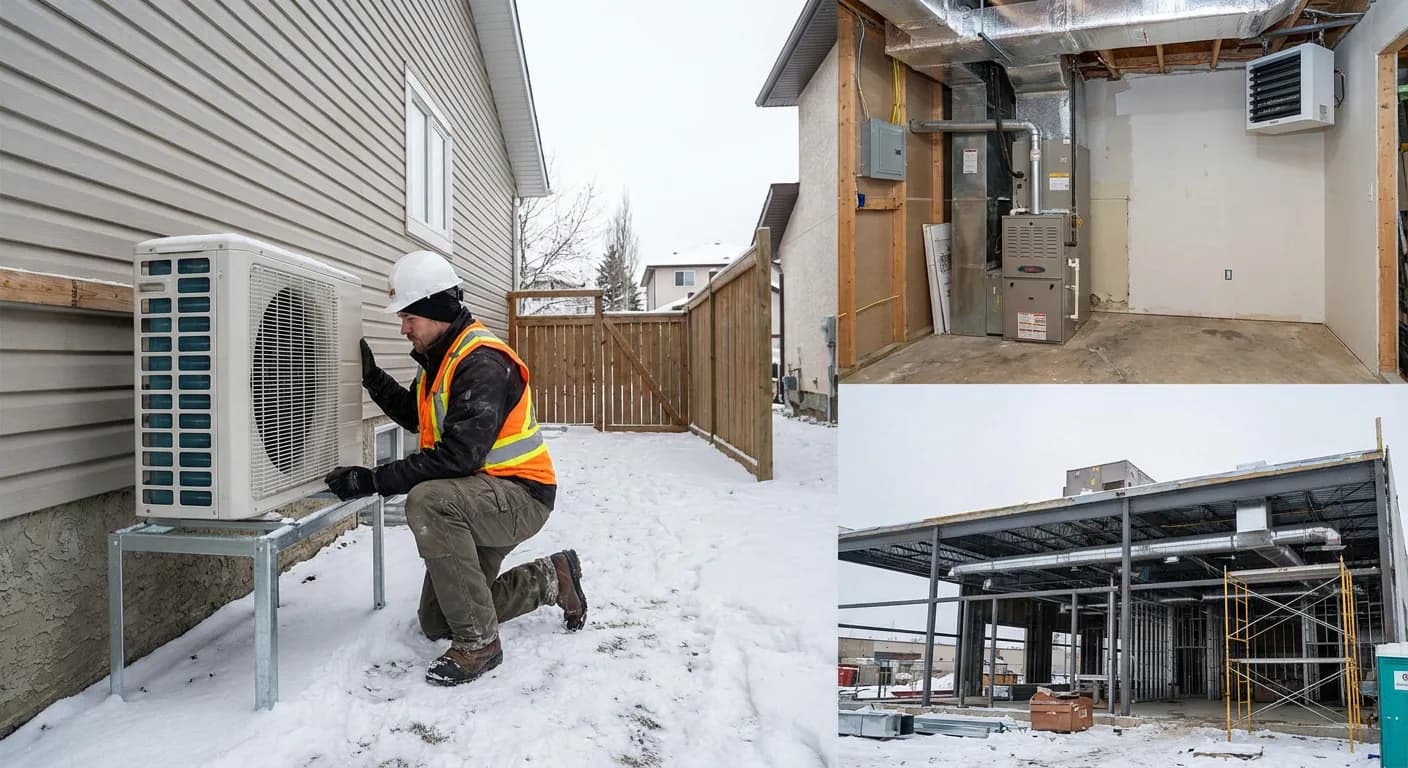
TL;DR
A mini split heat pump in Canada can provide efficient heating and cooling, especially in buildings without ductwork. Success depends on cold-weather capacity, accurate sizing, indoor head placement, electrical capacity and backup heat planning, not choosing the most heavily advertised model.
Why Ductless Heat Pumps Are Getting More Attention
Ductless heat pumps have moved well beyond cottages, additions and occasional room cooling. They are now a serious retrofit option for older houses, commercial spaces and homes heated by electric baseboards, boilers or oil systems.
For many owners, a mini split heat pump in Canada is now part of a broader plan for comfort, electrification and lower energy use.
The number of heat pumps installed in Canadian homes increased from about 400,000 to 850,000 over a 15-year period. Adoption remains uneven, but Maritime provinces have moved much faster than the national average. Heat pumps became the primary heating source in 32% of New Brunswick households, 27% in Prince Edward Island and 21% in Nova Scotia.
The Canadian Climate Institute found that heat pumps were the lowest-cost heating and cooling option in two-thirds of its modelled scenarios. A standard system with electric backup had an average lifetime cost about 13% below a gas furnace paired with air conditioning.
Those results do not mean every installation produces the same outcome. Electricity rates, the existing heating fuel, insulation and local winter temperatures all matter. The Canadian cost analysis examined different cities, housing types and energy-price assumptions.
The strongest applications often involve replacing expensive resistance or oil heat while adding air conditioning. A poorly selected system can leave cold rooms, high backup heat use or unwanted noise. Equipment selection and building assessment have to come before the sales pitch.
What Does a Mini Split Heat Pump in Canada Cost?
There is no reliable national installed price for every property. Cost depends on capacity, the number of indoor units, cold-climate performance, electrical work, line routing and site access.
A Yukon study cited an initial mini-split benchmark of roughly $1,500 to $2,000 per ton of cooling capacity. It also found that mini splits could cost about 30% more than other heat pump configurations. That is a research benchmark, not a current contractor quote or a complete installed budget.
| Cost factor | Why it changes the project |
|---|---|
| Single-zone or multi-zone | Additional heads require more equipment, controls, drainage and refrigerant piping. |
| Cold-climate model | Enhanced low-temperature equipment may cost more than a standard cooling-focused unit. |
| Electrical capacity | The panel, available breaker space and wiring route must suit the selected equipment. |
| Outdoor unit location | Snow clearance, service access, vibration control and line length affect the installation. |
| Building layout | Closed rooms may need separate heads rather than relying on air movement through doorways. |
Retail equipment prices rarely show the whole job. A complete proposal may also involve mounting hardware, condensate drainage, wall penetrations, controls and weather protection. Required permits must be confirmed for the property.
We build the scope around the site rather than multiplying floor area by a generic price. A detached Calgary house, a laneway-style suite and a commercial office can need very different designs, even when their advertised equipment capacity looks similar.
How Well Do Mini Splits Work in Canadian Winters?
Cold-climate models can keep operating at very low temperatures. That does not mean one unit can meet a building’s full heating demand during the coldest Calgary weather.
A heat pump moves heat rather than creating it through electric resistance. In favourable conditions, a modern system can provide about three units of heat for each unit of electricity consumed. Its output and efficiency still decline as outdoor temperatures fall.
Natural Resources Canada says standard air-source models may need supplemental heating around -10°C to -15°C. Cold-climate systems are designed for lower temperatures, and some models can operate near -30°C. Owners should distinguish between three separate specifications:
- Operating limit: the temperature at which the equipment can continue running.
- Available capacity: the heat it can deliver at that outdoor temperature.
- Building demand: the heat the property loses under the same conditions.
A unit may keep running in deep cold while producing less heat than the building needs. Backup can come from an existing furnace, boiler, baseboard system or another properly designed source. The right arrangement depends on the property.
We assess insulation, air leakage, windows, exposed walls and room layout before treating catalogue capacity as sufficient. The federal overview of heat pump performance also stresses proper selection, sizing and installation.
Outdoor placement matters in Calgary. The unit needs appropriate clearance from drifting snow, roof runoff and service obstructions. Defrost water also needs somewhere suitable to drain and freeze without creating another problem.
What Is the Best Mini Split to Buy?
The best system is the one matched to the building’s design heat loss, room layout and winter conditions. Brand recognition alone does not establish whether a specific indoor and outdoor unit combination is suitable.
Start with verified low-temperature data. Heating output at a mild rating condition does not show what will happen during a cold snap. Compare capacity and coefficient of performance at lower temperatures, rather than headline cooling efficiency.
For Canadian applications, useful selection details include:
- Rated heating output at relevant winter temperatures
- Capacity retained as outdoor temperature falls
- Variable-speed compressor operation
- Basepan heating and defrost controls
- HSPF2 heating efficiency and SEER2 cooling efficiency
- Indoor and outdoor sound information
- Parts support and qualified local service access
- The exact matched combination of indoor and outdoor model numbers
Single-zone equipment can be a strong choice for a basement, addition, workshop or open living area. Multi-zone equipment serves several spaces from one outdoor unit. Each connected head affects system operation, capacity allocation and piping complexity.
Do not assume that more heads always produce a better result. A small bedroom can have a much lower load than a large open main floor. Oversized indoor units may cycle poorly or create noticeable temperature swings.
We compare room requirements before deciding how many heads belong on the system. We also consider whether a centrally located unit can move air effectively. Closed doors, stairwells and narrow hallways often limit that approach.
What Are the Disadvantages of a Mini Split?
The main drawbacks are upfront cost, visible indoor equipment, room-by-room design limits and reduced output in severe cold. Maintenance and installation quality also have a direct effect on performance.
Wall-mounted heads remain visible inside the room. Ceiling cassettes and floor-mounted units can offer different aesthetics, but they introduce their own framing, access and drainage requirements.
Ductless systems also do not distribute heat through closed rooms as a central duct system does. One head in a hallway should not be expected to heat every bedroom evenly. Air movement depends on the floor plan, door position and temperature difference between spaces.
Other practical disadvantages include:
- Filters require regular cleaning.
- Indoor coils and drain systems need service access.
- Outdoor units periodically enter defrost mode during winter.
- Multi-zone refrigerant piping can be extensive.
- Condensate drainage must be planned for cooling operation.
- Some properties need electrical upgrades or a revised backup heat strategy.
Mini-split filtration is useful, but it is not a substitute for ventilation. The indoor head recirculates and filters room air. It does not bring fresh outdoor air into the building.
Installation errors can outweigh good equipment specifications. Poor flare connections, incorrect refrigerant work, weak mounting and bad drainage can cause reliability problems. Refrigerant and electrical work should be completed by qualified trades, with permits confirmed for each property.
Noise deserves attention as well. Modern variable-speed units are often quiet, but placement still matters. Mounting an outdoor unit beside a bedroom or on a resonant wall can make normal operation more noticeable.
Should You Choose Ductless or Central Equipment?
Choose ductless equipment when the property lacks usable ducts or needs independent zones. A central heat pump may be more practical when properly sized ductwork already reaches the rooms that need conditioning.
A mini split avoids the cost and disruption of adding large air ducts. That makes it useful in older Calgary homes with boilers, radiators or electric baseboards. It can also suit additions where extending the existing system would be difficult.
Central equipment has its own advantages. Supply and return ducts can serve enclosed bedrooms more consistently. The system also keeps most air-distribution equipment out of the occupied rooms.
| Property condition | Option to investigate |
|---|---|
| No existing ducts | Ductless single-zone or multi-zone system |
| Serviceable ducts throughout | Central air-source heat pump |
| One persistent hot or cold area | Targeted single-zone unit |
| Large house with closed rooms | Central, multi-zone or hybrid design |
| Existing furnace worth retaining | Integrated dual-fuel assessment |
The decision is not always either-or. Some properties use central equipment for the main house and a ductless unit for an addition or upper floor. Others retain an existing heating source for peak winter demand.
In our projects, we inspect duct condition and room airflow before recommending a format. Existing ducts are not always suitable. Their size, insulation, leakage and return-air arrangement must support the proposed equipment.
Commercial spaces add another layer. Occupancy, internal heat from equipment, operating schedules and separate tenant zones can change the load. Controls must be planned with the mechanical design rather than added after installation.
Rebates, Recalls and Planning the Installation
Incentives can affect the budget, but programs and eligibility rules change. Property owners should confirm current requirements directly with the program before ordering equipment or starting work.
The former Canada Greener Homes Grant offered up to $5,000 for eligible cold-climate equipment and up to $600 for EnerGuide evaluations. The grant is now closed. Other federal, provincial or utility programs may have separate rules, approved product lists and application deadlines.
Do not treat an old rebate advertisement as current approval. Confirm the exact outdoor model, every indoor model and the matched system reference requested by the program. Purchase timing, energy evaluations and contractor documentation may also matter.
Safety notices require the same model-specific approach. A 2024 recall affected certain Daikin, Amana and Goodman-branded heat pumps because of overheating risk after power interruptions. That notice did not mean every product from those brands was affected. Owners should check the Canadian recall notice against their exact model.
Before installation, we coordinate the mechanical, electrical and building details. Our review covers equipment location, wall penetrations, condensate routing, controls, backup heat and future service access. Gas, electrical and refrigerant work requires qualified trades, and permit requirements are confirmed for the property.
For Calgary, Airdrie, Cochrane, Okotoks and Chestermere properties, the final decision should come back to heat loss and layout. A properly planned ductless system can provide efficient year-round comfort. The equipment label alone cannot tell you whether it will heat every room on the coldest day.